


From Pioneer to Pace-Setter: Alex Eala and a New Southeast Asian Wave
- Edward McGhee

- Jan 18
- 5 min read
Alex Eala is not just the standard-bearer for Filipino tennis – she is at the forefront of something larger.
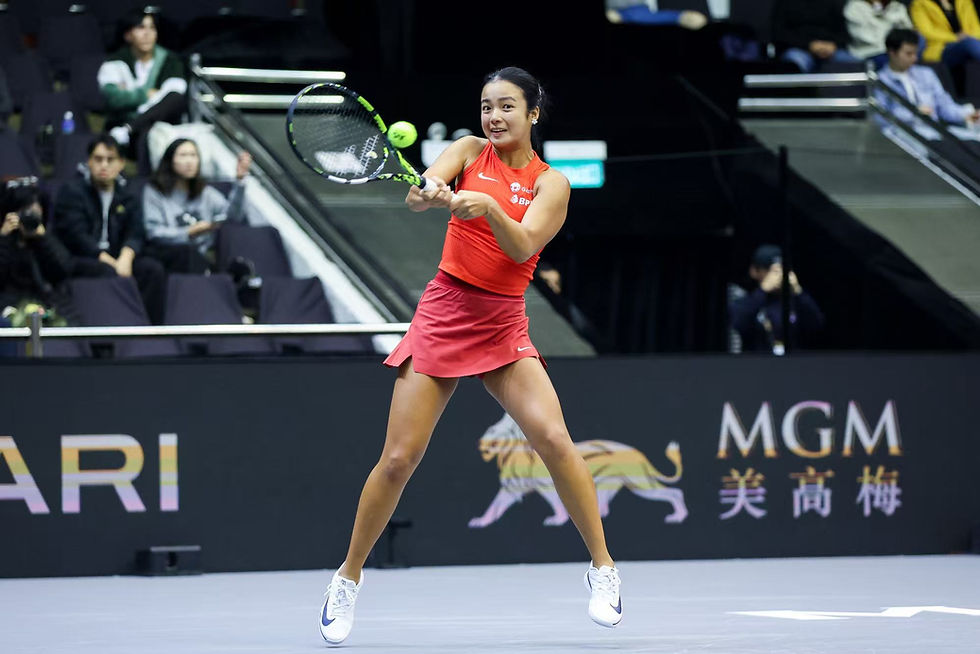
As she prepares to make her Australian Open main-draw debut, the Filipino tennis sensation does so not in isolation, but as the most visible figure in a historic moment for tennis in her part of the world. For the first time, four players representing Southeast Asian nations will contest a Grand Slam singles main draw – a significant milestone for a region that has long been under-represented at the sport’s highest level.
Eala, now sitting at a career-high No. 49 in the WTA rankings, remains the clear focal point, both at home and abroad. Yet the significance of her rise is magnified by the fact that she is not alone. At the 2026 Australian Open in Melbourne, she will be joined by Janice Tjen of Indonesia, as well as Mananchaya Sawangkaew and Lanlana Tararudee of Thailand, with all four making their debuts in the main draw in Australia.
Eala's impact in the Philippines cannot be overstated. When the 20-year-old beat three Grand Slam champions – including legendary six-time major winner Iga Swiatek – in a semifinal run at the prestigious Miami Open last year, it created a huge wave of Eala-driven tennis hysteria in her home country that shows no sign of abating. That moment was reminiscent of when Thai tennis legend Paradorn Srichaphan burst onto the scene in the early 2000s – most notably beating all-time great Andre Agassi at Wimbledon in 2002. Srichaphan became the first man from Asia to reach the top 10. He beat a total of six top-10 players that year, among them then-No. 1 Lleyton Hewitt, and became a national (and international) phenomenon.
That was an era with very few Asian players on the tour, never mind Southeast Asian ones. Srichaphan's impact was such that he appeared on the cover of Time magazine's Asia edition in 2003. In similar fashion, Eala has since appeared on the covers of Vogue and Tatler in the Philippines. Srichaphan's breakthrough paved the way for the Thailand Open, an ATP event held in Bangkok from 2003 to 2013. Similarly, Eala's rise has contributed to the creation of the Philippine Women's Open, the first-ever WTA 125 event to be staged in the country. That event's first edition is scheduled to take place later this month during the second week of the Australian Open.
Unfortunately, Paradorn’s peak was relatively brief, but his impact was significant. Post-career, he remains deeply involved in Thai tennis, running his own academy in Bangkok, where one of the other Australian Open debutants, Lanlana Tararudee, trains. Today, Asian tennis is far deeper and more established, yet Alex Eala has the potential to be even more impactful, if she hasn't been already.
Attention now turns to her Australian Open main-draw debut, where she will face Alycia Parks – a powerful opponent and a decent first test on one of tennis’s biggest stages. As Eala prepares for that moment, she does so with encouragement from someone who understands what an Australian Open debut can feel like. Speaking to Tennis Asia TV in Macau – where Eala was competing in a high-profile exhibition event that itself reflected the scale of her breakthrough year – former world No. 2 and Australian Open champion Li Na (Eala's team captain at the event) was asked to recall her own early experiences at Melbourne Park and to offer advice ahead of Eala’s debut.
“I remember the first time I was playing third round against Maria [Sharapova] in Rod Laver Arena,” Li said. “I was so nervous. I didn’t even know if I could walk on the court. Even after finishing the match, back to the locker room, I was like, ‘Oh my, it’s finished!’”
Li is a legend of Asian tennis, and spoke warmly about Eala’s potential. “I really love her personality. She’s played well, she’s so young, and she already has a lot of experience. So I believe she can do much, much better.”
That admiration runs both ways. Speaking in Macau, Eala reflected on the significance of standing alongside Li Na – a player she grew up watching and one she viewed as a trailblazer for Asian tennis. “Yeah, she very much was someone I watched growing up,” Eala said. “Of course, I think she was our leading lady for Asia when I was growing up. So just to stand beside her is such a joy.” Once inspired by Asia’s standard-bearer, Eala is now occupying a similar space herself – giving inspiration to many across her region.
When asked about her thoughts heading into her first Australian Open main draw, Eala struck a note of openness and optimism. “I’m so excited,” she said. “I’ve been preparing this whole pre-season. I haven’t had much success at the Australian Open in qualifying before, but every year is a different story. I’m so eager to be out on that court.”
While Alex Eala continues to lead the way as a pioneer for Filipino tennis, the presence of a cohort of young Southeast Asian women rising alongside her adds another compelling dimension. All four are aged 23 or younger, leaving significant room for growth and the possibility of sustained progress rather than a fleeting moment. A healthy sense of competition is beginning to take shape – one that can raise standards and sustain momentum – while Eala remains at the forefront. Together, their rise has the potential to generate genuine excitement for tennis across Southeast Asia, and to carry that energy well beyond the region.
That regional perspective was clear when Eala reflected on her gold medal at the Southeast Asian Games in Thailand – the first for a Filipino player in singles since 1999. She spoke not just about personal achievement, but about what representing the region means more widely. “It’s very unique to the people in our region,” Eala said. “That shared experience is what makes it special.” At that same event, Tjen, Sawangkaew and Tararudee all won medals of their own, further highlighting the talent among this crop of players.
The promise of these Southeast Asian ladies has also been demonstrated in other ways. Janice Tjen enjoyed a remarkable rise last year, climbing from outside the top 400 to near the top 50. She announced herself on the biggest stage by defeating a seeded opponent at the US Open, becoming the first Indonesian woman to win a Grand Slam singles match since Angelique Widjaja at the French Open in 2003. Tjen also lifted the title in Chennai, becoming the first Indonesian to win at WTA Tour level in 23 years.
Eala, meanwhile, made more history of her own at the US Open, recording the first Grand Slam singles victory by a Filipino player in the Open Era with her dramatic win over Clara Tauson. For Thailand, Mananchaya Sawangkaew and Lanlana Tararudee are breaking new ground by making their Grand Slam main-draw debuts, marking the first time since the 2011 US Open that two Thai women have featured in a singles main draw at a major. Furthermore, in 2025, Sawangkaew became just the third Thai player in history to crack the WTA top 100.
Taken together, the timing and youth of this group point not to a fleeting spike, but to a foundation on which something far more enduring could be built. Their debuts in Melbourne feel less like an arrival, and more like the start of a longer journey. It will be fascinating to see where it leads.


Comments